
The European Digital Identity Wallet is opening a new chapter for digital banking. It gives banks a new way to identify customers, authenticate users, and verify trusted attributes while keeping the user in control of what data is shared.
For financial institutions, the EUDI Wallet represents a clear opportunity: simpler onboarding, stronger trust, and less friction at every step of the customer journey. EUDI Wallet Gateway by iDAKTO supports banks across both sides of this equation: verifying wallet-based identity data and issuing bank credentials into wallets.
What the EUDI Wallet changes in practice
The EUDI Wallet introduces a new model for sharing trusted identity data, and banks now need to prepare for its adoption.
Under eIDAS 2.0, they will be required to accept the EUDI Wallet from the end of 2027. Yet this regulatory obligation also creates a significant opportunity.
As it rolls out alongside the AMLR, which will harmonize customer due diligence requirements across the EU from July 2027, the EUDI Wallet can simplify the collection and verification of trusted identity data, while leaving KYC checks and risk analysis firmly in the hands of banks.
Instead of asking users to upload documents, enter data manually or repeat identity checks across services, banks will be able to request verified digital attributes directly from a customer’s wallet, with user consent built into the wallet experience by design.
At the center of this model is the PID, or Personal Identification Data: the core set of identity attributes held in the wallet and issued by an authorized provider. According to the current EUDI Wallet framework, the mandatory PID attributes for a natural person include:
- family name,
- given name,
- date of birth,
- place of birth,
- nationality.
For banks, this changes the verification logic. The question is no longer only: “Can we verify this document?” It becomes: “Can we request, receive and verify certified identity attributes from a trusted wallet?”
In practice, this means banks can receive identity data in a structured, digital, and verifiable format. The user remains in control of the sharing process, and the bank can rely on technical evidence to support its internal onboarding, authentication, or compliance with workflows.
The EUDI Wallet can support several banking use cases:
- KYC onboarding: using certified identity attributes to accelerate account opening.
- KYC refresh : updating customer identity data from their wallet during periodic reviews or remediation campaigns.
- Strong Customer Authentication: relying on wallet-based proofs or bank-issued attestations for high-assurance journeys.
- Account recovery: helping users recover access through a trusted digital identity.
- Attribute verification: checking specific data such as age, address, eligibility or other trusted attributes.
- Attestation issuance: allowing banks to issue credentials that customers can store in their wallet and reuse later.
- Digital signature journeys: Providing verified identity data into contract-signing processes.
For financial institutions, the EUDI Wallet is thus a new trust infrastructure for digital banking.
EUDI Wallet for customer onboarding: the path to a one-click identity experience
Customer onboarding is one of the most immediate and valuable use cases for banks.
Today, opening a bank account online can still be long and fragmented. A customer may need to scan an ID document, take a selfie, fill in personal information, wait for verification, provide additional proof, and repeat similar steps in future journeys.
The EUDI Wallet turns onboarding into a simpler trust exchange: customers share verified identity data from their wallet, and banks receive reliable data ready to support their onboarding process.
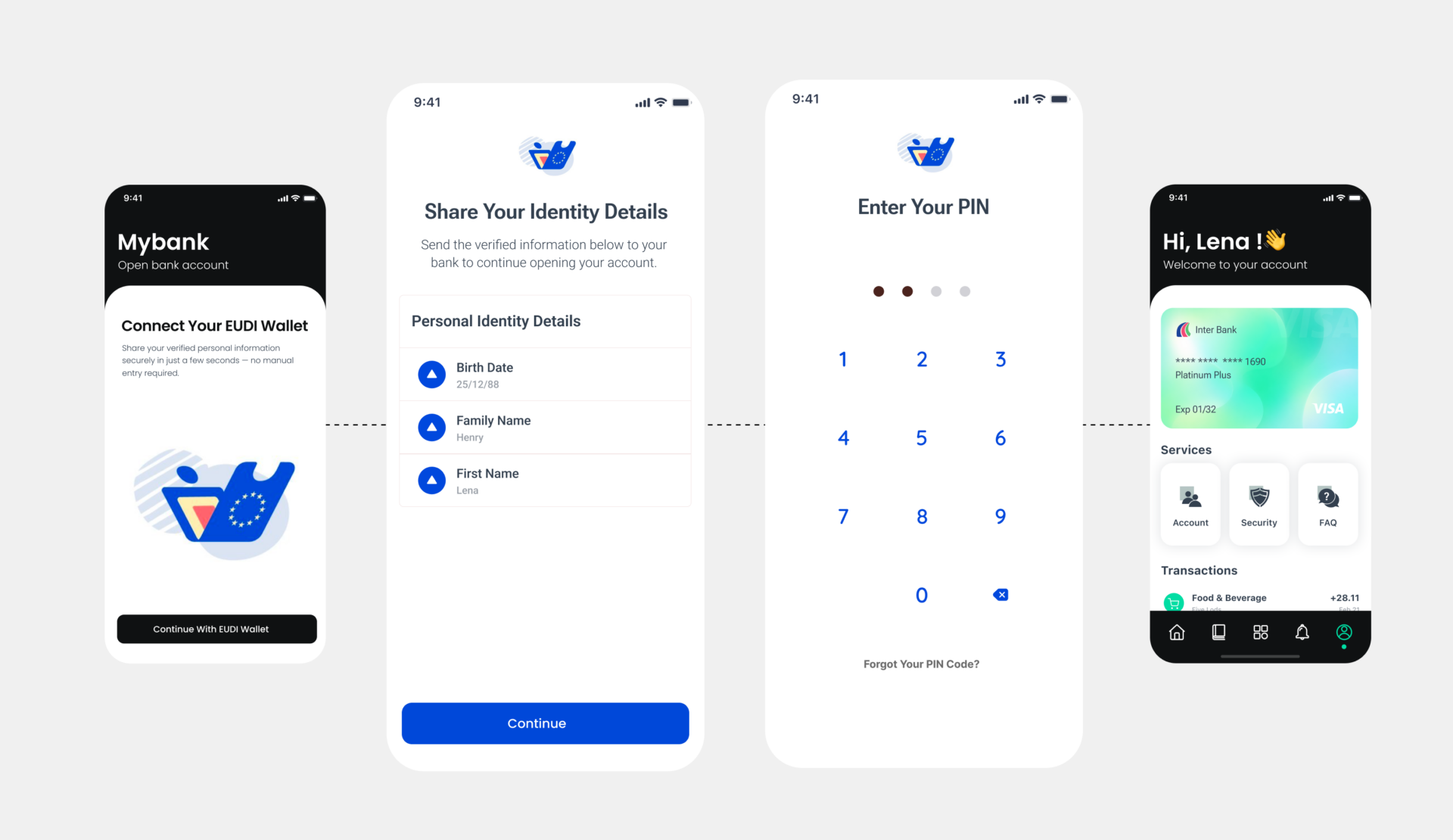
For the customer, this means a faster, smoother experience: fewer forms, fewer document uploads, and fewer repetitive checks. In the best case, onboarding moves closer to a one-click identity experience.
For the bank, the benefits are concrete:
- Faster onboarding
Customers can share verified identity data in a few steps, helping reduce friction and drop-off.
- Higher data quality
Banks receive structured digital attributes rather than relying only on document images or manually entered information.
- Stronger fraud resistance
Identity data comes from a trusted wallet and can be checked through cryptographic verification mechanisms.
- Compliance by design
Wallet-based identity sharing supports strong assurance and helps align onboarding with KYC requirements.
- Improved customer experience
The user stays in a familiar banking journey and only uses the wallet when trusted data needs to be shared.
- Seamless workflow upgrades
Wallet-based onboarding can be added as an additional identification route within existing journeys, while preserving alternative workflows where needed.
Meet EUDI Wallet Gateway by iDAKTO
he EUDI Wallet Gateway by iDAKTO is an interoperability layer built on the iDCluster® technology platform. It helps banks connect to the EUDI Wallet ecosystem through a simple and controlled integration, sitting between the bank’s systems and compatible digital wallets to handle wallet-specific complexity while the bank retains full control of its customer journey, business rules and backend processes.
It covers both sides of the EUDI Wallet integration picture through two dedicated modules:
The Verifier module supports the consumption of wallet-based identity data, with capabilities to:
- Request trusted identity data from a customer’s wallet;
- Receive and verify PID (Personal Identification Data) and attestations;
- Support authentication and sensitive-operation journeys;
- Integrate wallet-based identity into existing customer onboarding workflows.
The Issuer module covers the other side of the equation, with capabilities to:
- Issue bank credentials directly into a customer’s wallet;
- Deliver bank-managed attestations in a reusable digital format;
- Enable customers to store and reuse these attestations across services.
EUDI Wallet Gateway by iDAKTO gives financial institutions a complete integration path into the EUDI Wallet ecosystem, without having to build or maintain wallet protocols, credential formats and interoperability logic internally.
Why it helps banks
EUDI Wallet Gateway by iDAKTO is designed to make EUDI wallet adoption easier, faster and safer for financial institutions.
One interoperability layer
EUDI Wallet Gateway connects the bank to the EUDI Wallet ecosystem through a dedicated layer that manages standards, formats, and wallet interactions; covering both identity verification and credential issuance.
Customer journey continuity
The bank remains in control of the user experience. In a web journey, the QR code can be displayed directly in the bank’s own interface. In a mobile journey, the bank can manage the app-to-app handoff and return flow.
Built for banking environments
Both solutions are designed to fit into regulated IT environments, with API-based integration, traceability, security controls and deployment models adapted to enterprise constraints.
Flexible deployment
Depending on sovereignty, security and operating requirements, EUDI Wallet Gateway can be deployed in SaaS, private cloud or on-premises environments.
Future-ready architecture
EUDI Wallet Gateway embeds evolving regulatory and interoperability requirements by design, enabling banks to stay aligned as the European framework continues to develop.
Digital identity adoption is creating new opportunities for banks
The EUDI Wallet is no longer an abstract future scenario. Across Europe, digital identity adoption is accelerating, and France Identité illustrates this momentum well, with 5 million users and counting.
For banks, this growing adoption changes the equation. Customers are becoming more familiar with digital identity in their daily lives, creating the right conditions for trusted wallet-based journeys. As a leading digital identity provider, iDAKTO helps financial institutions move from ambition to implementation with EUDI Wallet Gateway; covering both identity verification and credential issuance in a single integration.